Root-cause dry eye treatment, designed for you.
EMFACE® for TMJ Dysfunction
A Neuromuscular Approach to Jaw Pain and Dry Eye Symptoms
Temporomandibular joint (TMJ) dysfunction is a common condition affecting the jaw muscles and joint responsible for chewing, speaking, and facial movement. Patients with TMJ disorders often experience jaw pain, muscle tension, headaches, and facial fatigue.
Emerging clinical understanding suggests a relationship between jaw muscle overactivity, trigeminal nerve stimulation, and ocular surface symptoms such as dry eye.
At our clinic, we use EMFACE® as a non-invasive neuromuscular therapy to help regulate jaw muscle activity. By reducing excessive muscle contraction and nerve stimulation, EMFACE can relieve TMJ symptoms and may secondarily improve dry eye discomfort in some patients.
FDA-Cleared Treatment for TMJ Dysfunction
EMFACE received FDA clearance in 2025 for the treatment of temporomandibular joint dysfunction and associated symptoms.The cleared indications include:
- Relief of symptoms associated with muscle spasm
- Treatment of TMJ dysfunction and associated pain
- Muscle re-education
- Increased local blood flow
- Maintenance or improvement of the mandibular range of motion
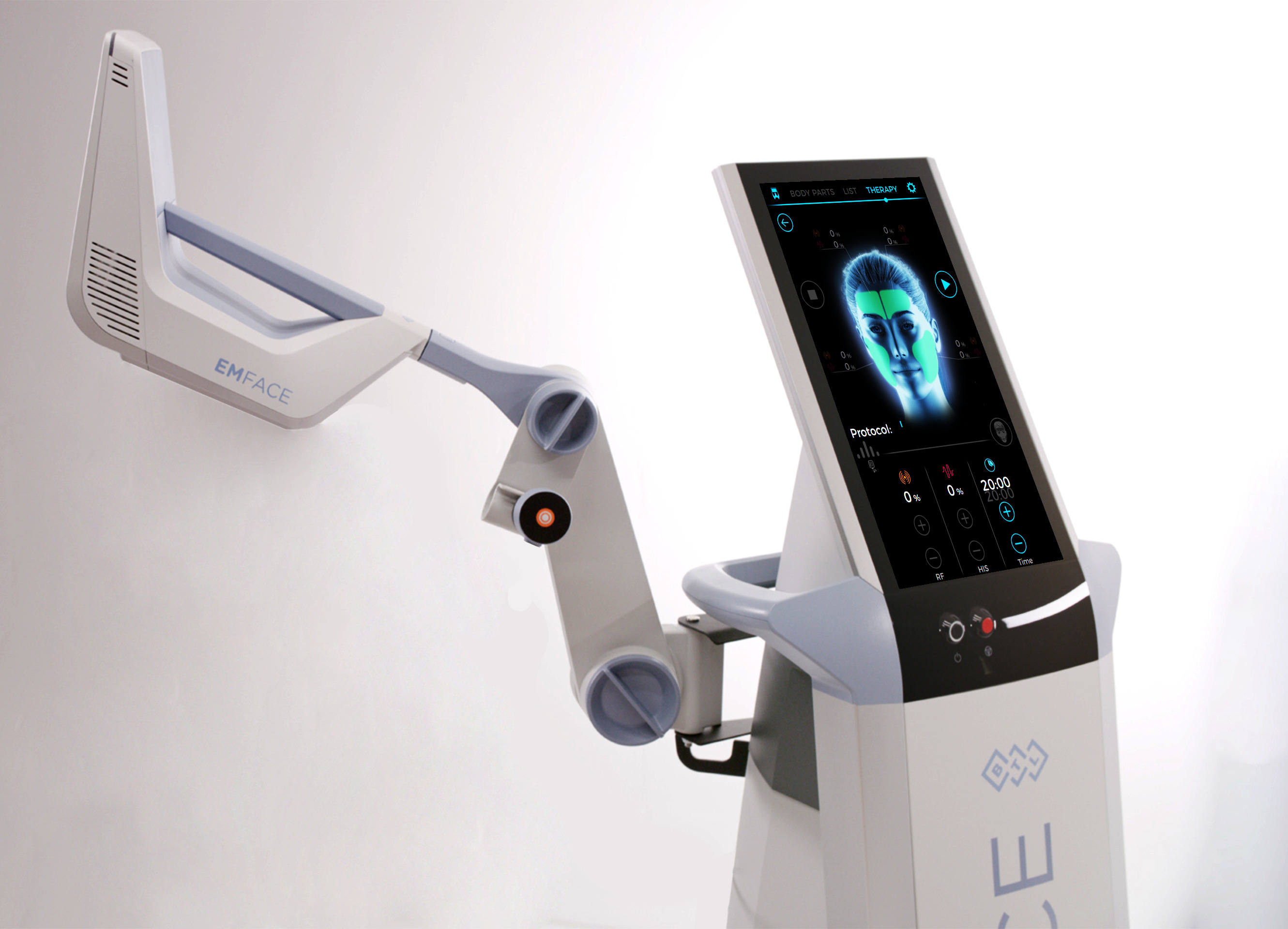
EMFACE uses two synchronized technologies:
Radiofrequency (RF)
Gently warms tissue to increase circulation and relax muscle tension.
HIFES® (High-Intensity Facial Electrical Stimulation)
Stimulates facial muscles to improve neuromuscular coordination and balance. Together, these technologies allow providers to address the muscular component of TMJ dysfunction without injections or surgery.
The Trigeminal Nerve and TMJ
The trigeminal nerve (cranial nerve V) is the primary nerve responsible for sensation in the face and motor control of chewing muscles.

Its mandibular branch (V3) innervates key muscles involved in TMJ disorders:
Masseter
Temporalis
Medial pterygoid
Lateral pterygoid
When these muscles become chronically overactive—often due to clenching, grinding, stress, or neuromuscular imbalance—they may produce:
Jaw pain
Facial tension
Headaches
Muscle spasms
EMFACE therapy helps regulate this system by stimulating and coordinating the masticatory muscles while reducing excessive neuromuscular activity.
In simple terms, this approach turns down the volume on an overactive trigeminal nerve pathway by restoring healthier muscle function.
How Trigeminal Over-Activity Can Affect the Eyes
The trigeminal nerve also provides sensory innervation to the ocular surface.
Scientific literature has shown that the trigeminal system plays a key role in:
Ocular surface sensation
Tear reflex pathways
Ocular discomfort signaling
https://www.ncbi.nlm.nih.gov/pmc/articles/PMC5717615/
When trigeminal pathways become overstimulated due to chronic facial muscle tension, they can contribute to symptoms such as:
Eye fatigue
Ocular discomfort
Reflex tearing
Dry eye symptoms
Why TMJ Treatment May Improve Dry Eye Symptoms
While EMFACE is not a primary treatment for dry eye disease, addressing trigeminal nerve over-activation may indirectly benefit ocular comfort in some patients.
Reducing jaw muscle hyperactivity may:
Decrease trigeminal nerve stimulation
Reduce facial and periocular tension
Improve neuromuscular balance
Lower neural amplification of ocular discomfort
Patients who suffer from both TMJ pain and chronic eye irritation sometimes report improvement in eye symptoms after jaw muscle therapy.
This reflects the interconnected nature of the eye–face–brain neurosensory system.
What to Expect From EMFACE TMJ Therapy
EMFACE treatments are:
Non-invasive
Needle-free
Comfortable
Approximately 20 minutes per session
A typical protocol includes a series of treatments over several weeks.

During treatment, applicators deliver synchronized radiofrequency and HIFES stimulation to the jaw muscles, improving muscle function while relaxing hyperactivity.
Over time, this process helps retrain the muscles of mastication and restore healthier function.
Who May Benefit
EMFACE TMJ therapy may be appropriate for patients experiencing:
Jaw pain or stiffness
Teeth clenching or grinding
TMJ-related headaches
Facial muscle tension
Limited jaw movement

Patients with both TMJ symptoms and chronic dry eye discomfort may particularly benefit from evaluation.
A Whole-System Approach
At our clinic, TMJ treatment is considered part of a broader eye–mind–body framework.
Dry eye symptoms may be influenced by:
Meibomian gland dysfunction
Ocular surface inflammation
Blink mechanics
Neurosensory pathways
Trigeminal nerve activation
By addressing jaw muscle dysfunction alongside ocular surface care, we aim to treat the entire neurosensory system involved in eye comfort.
Schedule a Consultation
If you suffer from TMJ pain, facial tension, or chronic dry eye symptoms, a comprehensive evaluation can determine whether EMFACE therapy may be appropriate.
References
- BTL Industries. FDA clearance expands EMFACE indications for TMJ dysfunction.
https://www.prnewswire.com/news-releases/btl-expands-emface-indications-with-new-fda-clearance-for-tmj-dysfunction-302528091.html - BTL Industries. EMFACE technology overview (RF + HIFES neuromuscular stimulation).
https://bodybybtl.com/solutions/emface/ - Dentistry Today. Innovation in TMJ management with EMFACE technology.
https://www.dentistrytoday.com/qa-bringing-innovation-to-tmj-management-with-emface-technology/ - Belmonte C, et al. Nerve mechanisms in dry eye disease.
https://www.ncbi.nlm.nih.gov/pmc/articles/PMC5717615/

Specialty Dry Eye Care Services
Find personalized eye care excellence with our comprehensive services. From eye exams to advanced diagnostics, trust us for all your vision needs.

Keep In Touch
For non-urgent questions or to learn more about our services, contact us today!

Dry Eye Specialist in Bellevue, Washington
Serving Eastside, Seattle, Kirkland, Redmond
Serving Eastside, Seattle, Kirkland, Redmond
Contact Info
- 1414 116th Ave NE Suite B
Bellevue, WA 98004 - Phone: (425) 502-7922
- Fax: (425) 502-7975
Hours of Operation
- Monday 8:00am - 6:00pm
- Tuesday 8:00am - 6:00pm
- Wednesday 8:00am - 6:00pm
- Thursday 8:00am - 6:00pm
- Friday By Appointment Only
- Saturday Closed
- Sunday Closed
- Monday
- Tuesday
- Wednesday
- Thursday
- Friday
- Saturday
- Sunday
- Monday
- Tuesday
- Wednesday
- Thursday
- Friday
- Saturday
- Sunday
© 2026 Dr. Harry Boparai. All rights Reserved - Accessibility Statement - Privacy Policy - Sitemap
Managed and Designed by 